

Artificial intelligence is one of the most frequently mentioned topics in the industry today, alongside automation powered by AI. However, its real impact is only just beginning to be understood – especially in the context of e-commerce and digital payments.
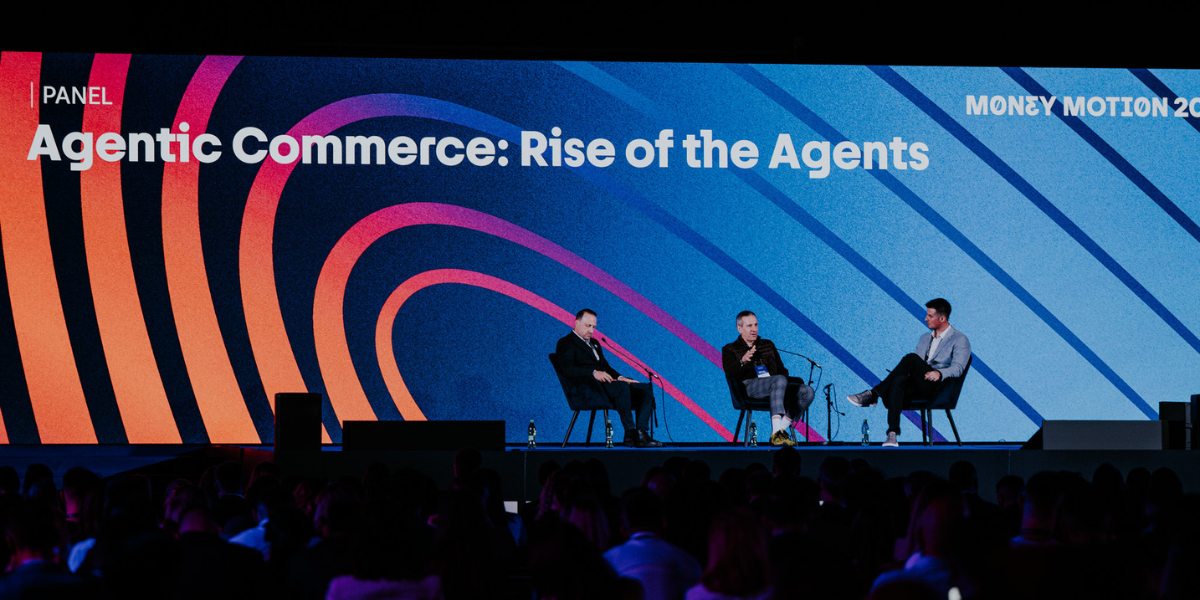
Damir Čaušević, moderator of this year’s Money Motion panel, led a discussion on the rise of AI agents, joined by Bartosz Ciolkowski, Division President for South East Europe at Mastercard, and Panagiotis Kriaris, Director at Unzer and Head of Business & Corporate Development.

The panel, titled “Agentic Commerce: Rise of the Agents,” was itself prepared with the help of artificial intelligence and focused on one of the most important upcoming shifts: agentic commerce.
Panagiotis Kriaris introduced the concept to the audience by explaining that agentic commerce refers to software acting as a digital agent that makes purchases on behalf of the user. The implications of this model are far-reaching – it is reshaping how the entire commerce infrastructure operates, while raising new questions around security, trust, and responsibility. Users are no longer making decisions independently but instead delegating them to software.
At the beginning of the panel, Bartosz Ciolkowski emphasised that we are witnessing a new transformation: “Just a year ago, the term ‘agentic’ did not even exist, as the industry was still focused on e-commerce. Previously, consumers would visit physical stores, interact with salespeople, and physically handle both products and payment methods.” e-commerce and online payments changed that entirely, requiring customers to trust that products they saw online and paid for in advance would actually be delivered. In the payments industry, it took years to build that trust. Now, a fifth element is being added to the existing ecosystem of consumers, merchants, banks, and payment providers – the agent.
As highlighted by Panagiotis Kriaris, several technological prerequisites must be met for agentic commerce to function. One of the key requirements is tokenisation, a fundamental security mechanism that replaces sensitive payment data with tokens. Without tokenisation, agents cannot execute transactions securely. Since agents are software, they interpret and “read” products differently than humans. This means merchants must invest in machine-readable product catalogues – if a product is not understandable to an agent, it effectively does not exist. The issue of identity also comes into play, introducing a new concept: KYA (Know Your Agent). Questions such as to who stands behind a given agent, what spending limits it has, and how transactions are authorised still need to be clearly defined. Existing infrastructure was designed for human users and must now adapt to agents. This includes new communication rules, standards between agents, merchants, and payment providers, as well as adjustments to current systems. As Panagiotis Kriaris concluded, “everything will require a kind of facelift.”
The panel also addressed the topic of fraud. The speakers agreed that fraud remains the number one challenge in the payments industry and will not disappear with the introduction of agents. On the contrary, new risks are emerging, including fraud targeting agents and merchants, manipulation of agent intent, and unclear liability in case of issues. Panagiotis Kriaris emphasised the importance of defining clear responsibility frameworks and developing new security protocols.

The rise of agents is also transforming the relationship between consumers and merchants. Bartosz Ciolkowski pointed out that consumers have always held significant power and control – previously comparing products across physical stores, and now through automated systems. Loyalty is decreasing and evolving into added value, personalisation, and new reward models such as cashback, points, or miles. Marketing is likely to rely more on algorithm-driven personalisation and less on traditional approaches.
Bartosz Ciolkowski and Panagiotis Kriaris shared advice for merchants and payment providers in this emerging era of agentic commerce. Merchants must ensure they are discoverable by agents, which requires high-quality, structured product catalogues. Close collaboration with payment providers and offering additional value will be essential for adapting to the new landscape.
Unlike e-commerce, which took decades to achieve widespread adoption, agentic commerce could grow significantly faster. When asked what the landscape might look like in 2030, Bartosz Ciolkowski noted that changes are expected to happen rapidly and encouraged everyone to remain open-minded and closely follow technological developments.